
Me: “You remind me of my childhood crush, pup.”
My son: “Ooh lala lala! Tell me who?”
Me: “Mowgli from Jungle Book.”
Adi: “What? Why? Is that even a compliment?”
Me: “Obviously not! Look at your hair, boy. I can barely see your face. Can you please cut your hair for God’s sake?”
My boy just went back to his books.
Me: “Adi, are you even listening?”
Adi: “Of course I’m listening. I’m just choosing not to obey you.”
That line stopped me in my tracks.
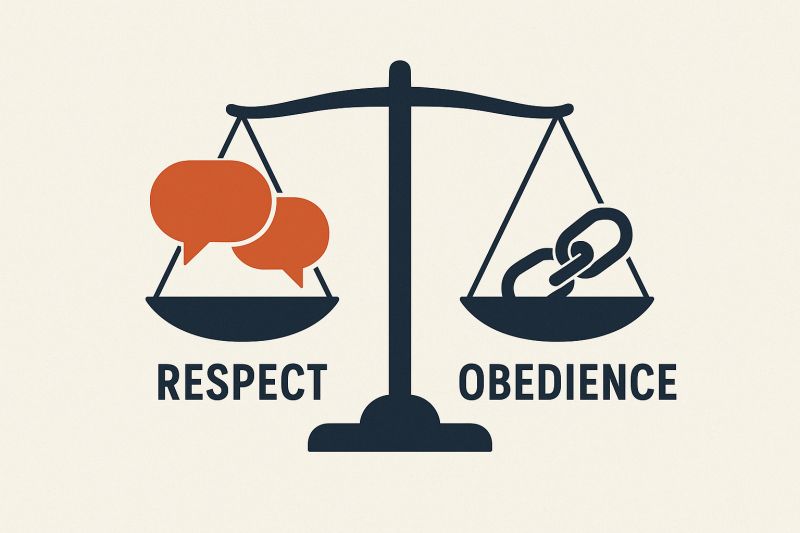
Growing up in a lower-middle-class Hindu household, I had learnt that if you were listening, you followed. If you didn’t follow, you weren’t respectful. I learnt that respect often meant obedience. Saying yes was safer than asking why.
As I sat with my son’s cheeky push-back, I recognised that even today, when I’m in groups, I notice a voice in me: “Careful—your objection might sound disrespectful.”
This isn’t just personal. It is cultural.
In Indian context, respect is vertical. It flows upward—towards parents, teachers, leaders. Questioning authority can easily be seen as breaking respect.
By contrast, in many Western contexts, respect is experienced as horizontal. Speaking your mind—even disagreeing publicly—is seen as engagement, not defiance. Silence there can be read as disengagement, whereas in India silence often communicates reverence.
When groups cross these cultural lines, misunderstandings multiply:
• A Western leader may perceive quietness as lack of participation, while for an Indian participant it may be the very act of showing respect.
• An Indian leader may hear objections as defiance, while for a Western participant it may be the clearest way to show commitment.
So how do we navigate this?
1. Name the cultural paradox upfront
• Say explicitly: “In some cultures, silence shows respect. In others, speaking up does. Let’s talk about how we want to read these signals here.”
→ This normalizes differences instead of leaving them unspoken.
2. Create a “challenge = care” frame
• Reframe objections as a sign of investment: “If someone disagrees, it means they care enough about the group to offer another view.”
→ This transforms dissent from threat into contribution.
3. Slow down your authority reflex: When you feel disrespected, pause. Ask yourself: “Am I reacting to the content… or to how my status feels questioned?”
→ This builds self-awareness in leaders, preventing escalation.
4. Honor courage across the spectrum
• For the outspoken: “Thank you for risking disagreement.”
• For the quiet: “Thank you for holding space in silence—I’d love to hear what’s alive for you when you’re ready.”
→ Both speaking up and holding back require courage, depending on the imprint.
5. Co-create a new definition of respect
• Instead of assuming, invite: “What would respect look like in this group, for this season of our work?”
→ This shifts respect from inherited code to a living, evolving agreement.
-Written By Anisha Pandya